

Introduction
If you have been dealing with foot pain, you have probably stood in a drugstore aisle staring at a wall of insoles. Some cost $15. Some cost $60. And somewhere in the back of your mind, you wonder if a custom orthotic from a specialist would actually be worth it. You are not alone in asking that question.
The truth is, both options serve a purpose. But they are not the same. Custom orthotics vs OTC insoles is not just a cost comparison. It is a question about fit, function, and what your feet actually need. In this guide, I will break down the real differences so you can make a clear, informed decision.
What Are Custom Orthotics?
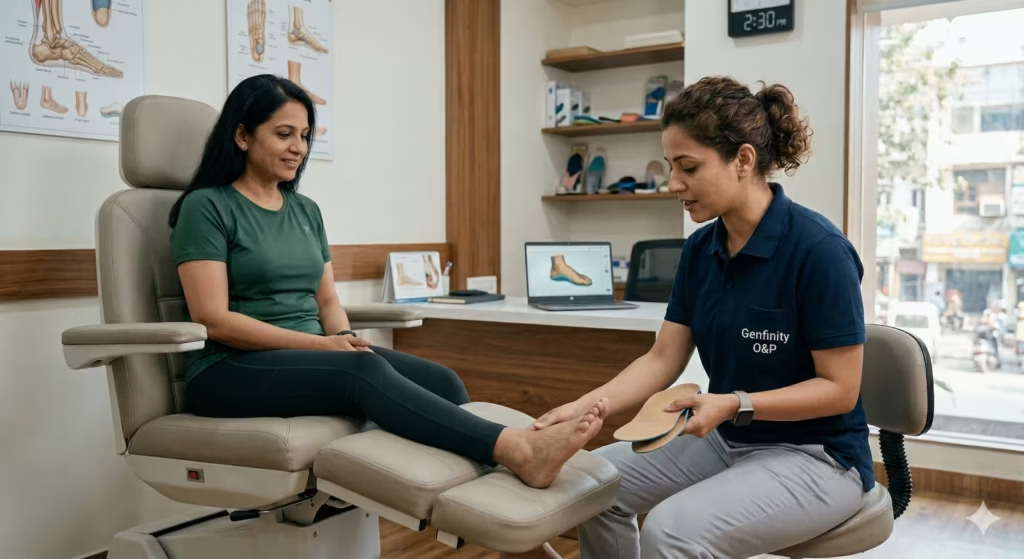
Custom orthotics are medical devices made specifically for your feet. A podiatrist or orthotist takes a detailed mold or 3D scan of your foot. They then design an insert that matches your unique arch shape, gait pattern, and specific condition.
These are not insoles you pull off a shelf. They are prescription devices crafted from medical-grade materials like carbon fiber, EVA foam, or rigid polypropylene. Each pair is built to address a defined clinical problem.
How Custom Orthotics Are Made
- A specialist evaluates your foot structure, gait, and symptoms
- A 3D scan, plaster cast, or foam impression is taken
- A lab fabricates the orthotic based on the prescription
- You return for a fitting and any needed adjustments
Custom orthotics are most effective for conditions like plantar fasciitis, flat feet and overpronation. These are structural issues that a generic insole simply cannot correct.
Types of Custom Orthotics
- Rigid orthotics: Made from carbon fiber. Best for controlling motion in flat feet or high arches.
- Semi-rigid orthotics: A blend of soft and firm layers. Good for athletes and active individuals.
- Soft orthotics: Cushioned and flexible. Used for diabetic feet or people with significant calluses.
What Are OTC Insoles?
Over-the-counter insoles are pre-made shoe inserts available at pharmacies, sporting goods stores, and online. They come in standard sizes and are designed for general comfort rather than specific medical conditions.
They can help with mild foot fatigue and basic cushioning. Many people find temporary relief using them. But they work best when your issue is minor and does not stem from a structural problem.
Common OTC Insole Types
- Cushioned insoles: Soft foam or gel. Reduce impact during walking or standing.
- Arch support insoles: Add some lift to the arch but not tailored to your foot.
- Heel cup insoles: Target heel pain and basic plantar fasciitis discomfort.
- Sport insoles: Designed for athletic activity with extra shock absorption.
Studies show that OTC insoles provide short-term comfort for mild conditions. However, a 2023 review published by the American Podiatric Medical Association found that custom orthotics produced significantly better outcomes for patients with chronic foot and lower limb disorders compared to generic insoles.
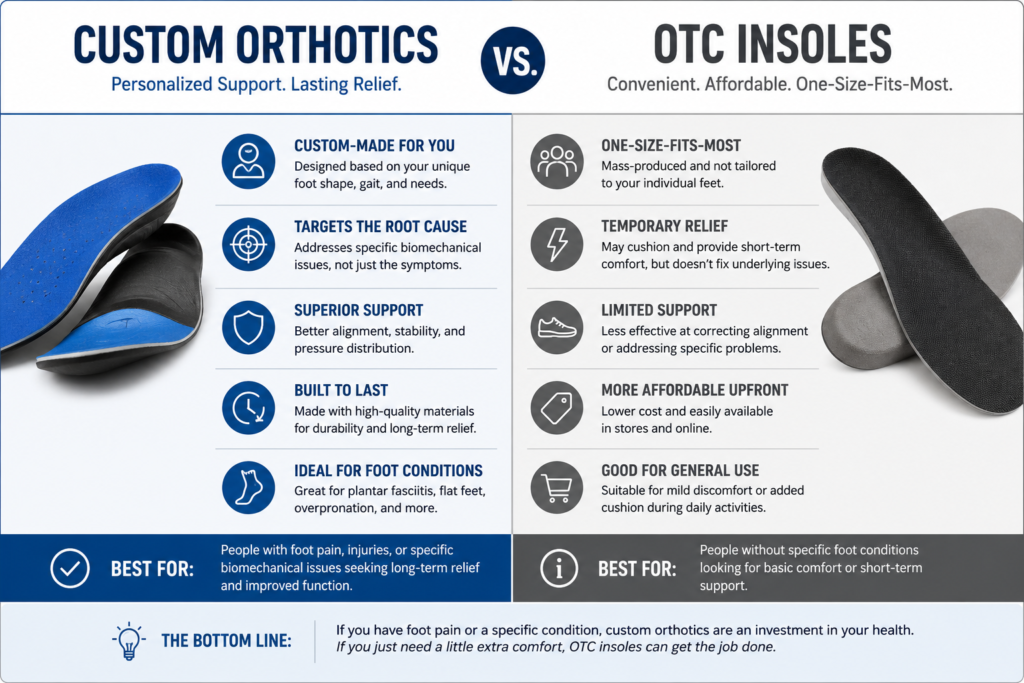
Custom Orthotics vs OTC Insoles: Side-by-Side Comparison
Here is a clear breakdown of how the two options compare across the most important factors.
When Custom Orthotics Make More Sense
Not every foot problem needs a custom solution. But there are clear situations where custom orthotics outperform anything off the shelf.
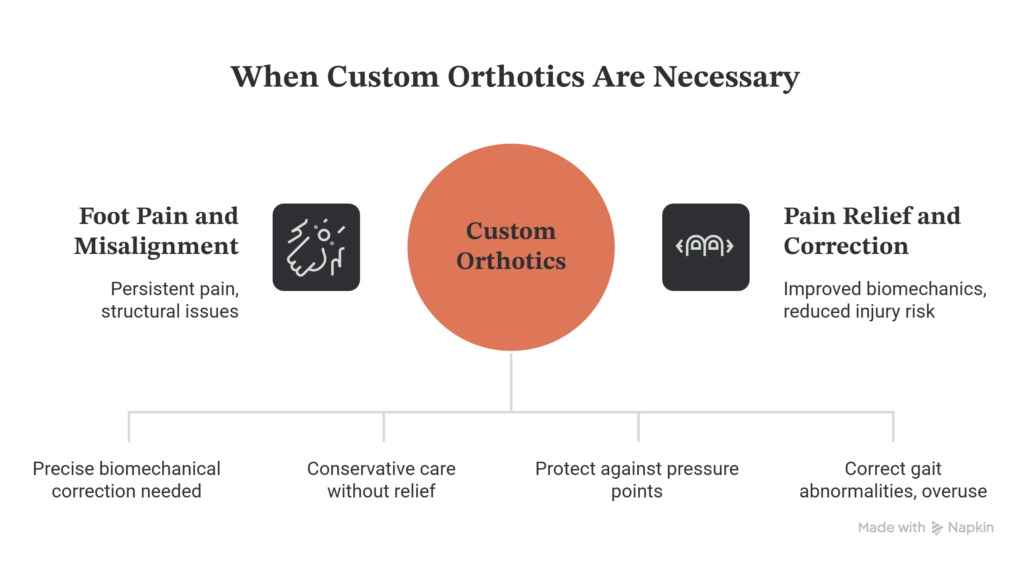
You Have a Diagnosed Foot Condition
If you have been told you have plantar fasciitis, flat feet, overpronation, or structural misalignment, a custom orthotic is often medically necessary. These conditions require precise biomechanical correction, not just cushioning.
Your Pain Is Persistent or Getting Worse
If you have tried multiple OTC insoles without relief, that is a strong signal. Persistent pain after six to eight weeks of conservative care is a common threshold used by specialists to recommend prescription orthotics.
You Are Managing Diabetes
Diabetic foot care requires custom-fit devices that protect against pressure points and ulcers. OTC insoles are not designed for this level of care. A certified orthotist or podiatrist should be involved in all footwear decisions for people managing diabetes.
You Are an Athlete with Recurring Injuries
Runners, cyclists, and team sport athletes who deal with shin splints, knee pain, or Achilles issues often benefit from custom orthotics. These devices can correct gait abnormalities that lead to overuse injuries. A standard insole does not address the root biomechanical cause.
When OTC Insoles Are a Good Choice
OTC insoles are not a lesser option across the board. For the right situation, they work well and save you money.
Your Discomfort Is Mild and Recent
If your feet are tired from a long day on hard floors or you are just getting back to walking regularly, an OTC insole can provide enough cushioning and support to get you through. This is a short-term comfort solution, not a medical treatment.
You Are Testing Whether Arch Support Helps
Some people are unsure if arch support is even the right approach. Starting with an OTC insole is a reasonable first step. If it helps, great. If not, that feedback is useful when you speak with a specialist.
You Need a Temporary Solution
Maybe your custom orthotics are being repaired or you are between appointments. A well-fitting OTC insole can bridge that gap without causing harm for most people.
Cost and Insurance: What You Need to Know
Cost is one of the biggest reasons people choose OTC insoles. The upfront price difference is real. But the long-term picture is more nuanced.
Understanding the Price Gap
Custom orthotics typically range from $200 to $800 depending on material, complexity, and provider. OTC insoles range from $10 to $60. At first glance, this looks like an obvious win for OTC products.
However, custom orthotics last two to five years with proper care. OTC insoles wear down in three to six months. Over a five-year period, a person replacing OTC insoles every four months could spend $150 to $900 in total, which approaches the cost of a single pair of custom orthotics.
Insurance and HSA Coverage
Many insurance plans cover custom orthotics when prescribed by a licensed physician or podiatrist. Flexible Spending Accounts (FSAs) and Health Savings Accounts (HSAs) often cover the cost as well. OTC insoles are rarely covered.
Check with your insurance provider before assuming custom orthotics are out of reach. Visit our custom orthotics and prosthetics guide to learn more about the clinical process and what to expect during an evaluation.
Practical Tips for Getting the Most From Your Insoles or Orthotics
Whether you go custom or OTC, how you use and care for your insoles matters. These tips apply to both options.
Breaking In Custom Orthotics
- Start by wearing them one to two hours per day
- Increase wearing time by one hour each day over two weeks
- Switch between orthotics and regular insoles during the break-in phase
- Report any unusual pain or pressure points to your orthotist immediately
Choosing the Right OTC Insole
- Match the insole to your foot type: flat, neutral, or high arch
- Look for medical-grade foam rather than basic gel pads
- Make sure the insole fits inside your shoe without bunching
- Replace every three to four months or when the cushioning compresses noticeably
Footwear Matters Too
No insole, custom or OTC, can overcome a poorly fitting shoe. Always pair your orthotics with supportive footwear that has a firm heel counter and adequate toe box space. Avoid slip-on styles if you are dealing with structural foot problems.
If flat feet are part of your concern, our detailed article on custom orthotics for flat feet covers how orthotics can reshape your arch support over time.
What the Research Says
The evidence base for custom orthotics has grown significantly over the past decade. Here is what current research tells us.
- Plantar fasciitis: A clinical trial published in the Journal of Bone and Joint Surgery found that custom orthotics reduced plantar fasciitis pain by up to 54% over a 12-week period compared to 32% for standard insoles.
- Overpronation: Research shows custom orthotics reduce excessive inward rolling of the ankle by correcting foot alignment at the subtalar joint. Generic insoles provide minimal correction for true overpronation.
- Knee and lower back pain: A 2022 meta-analysis found that custom foot orthotics contributed to measurable reductions in knee and lower back pain in patients whose symptoms were linked to foot mechanics.
- Diabetic foot care: The American Diabetes Association recommends therapeutic footwear and custom insoles as part of standard diabetic foot management to reduce ulcer risk.
For a deeper look at how overpronation affects your entire body, read our guide on what overpronation is and how to address it ?
How to Decide: A Simple Framework
If you are still unsure which option is right for you, use this decision framework.
Choose OTC Insoles If
- Your foot discomfort is mild and started recently
- You do not have a diagnosed structural condition
- You are looking for cushioning during everyday activities
- You want to test arch support before seeing a specialist
Choose Custom Orthotics If
- You have a diagnosed condition like plantar fasciitis, flat feet, or overpronation
- OTC insoles have not helped after six to eight weeks
- You have diabetes or another systemic condition affecting your feet
- You experience recurring injuries linked to your gait or foot mechanics
- Your job requires long hours on hard floors and your current solution is not working
Conclusion
The debate between custom orthotics vs OTC insoles comes down to one key question: is your foot problem structural or situational? A situational issue like general fatigue or mild soreness often responds well to a good OTC insole. A structural problem, one rooted in how your foot is built or how you walk, generally requires the precision of a custom orthotic.
OTC insoles are a reasonable starting point. But if your pain persists, worsens, or is tied to a known condition, investing in custom orthotics is not just a comfort decision. It is a health decision.
If you are ready to explore your options, explore our full guide to custom orthotics and prosthetics or read our resource on the best orthotics for plantar fasciitis to take the next step toward real foot relief.