

Introduction
Knee pain often feels like a knee problem. In many cases, the real issue starts lower down, in the way your foot strikes the ground. Orthotics for knee pain are designed to correct that root cause.
At Genfinity O&P, we fit patients with custom orthotics and prosthetics every week. A large share of them come in for knee pain, not foot pain. Once we correct foot alignment, knee pressure often drops within weeks.
Keypoints
◉ Knee pain often starts from poor foot alignment, not the knee itself
◉ Overpronation causes the leg to rotate inward and stress the knee
◉ Supination (outward roll) increases impact and joint pressure
◉ Uneven foot movement leads to uneven load on knee cartilage
◉ Pain usually appears during walking, running, or long standing
◉ Orthotics help realign the foot and reduce knee strain
◉ Custom orthotics work better than generic insoles
◉ They absorb shock and reduce pressure on the knee joint
◉ Improved gait helps prevent long-term knee damage
◉ Consistent use can reduce pain within a few weeks
This guide explains how foot mechanics affect the knee, who benefits most from orthotics, and what to expect during recovery.
How Foot Alignment Affects the Knee
Your foot is the foundation for your whole leg. When it rolls inward too far, a pattern called overpronation, the lower leg rotates with it. That rotation pulls on the knee joint with every step.
We cover this pattern in detail in our article on what overpronation is Understanding overpronation is the first step to understanding knee pain that has no clear knee injury behind it.
Over time, this rotation puts uneven load on the cartilage inside the knee. The inner or outer edge of the joint takes more pressure than it should. This uneven load is a common driver of chronic knee pain in walkers, runners, and people who stand for long hours.
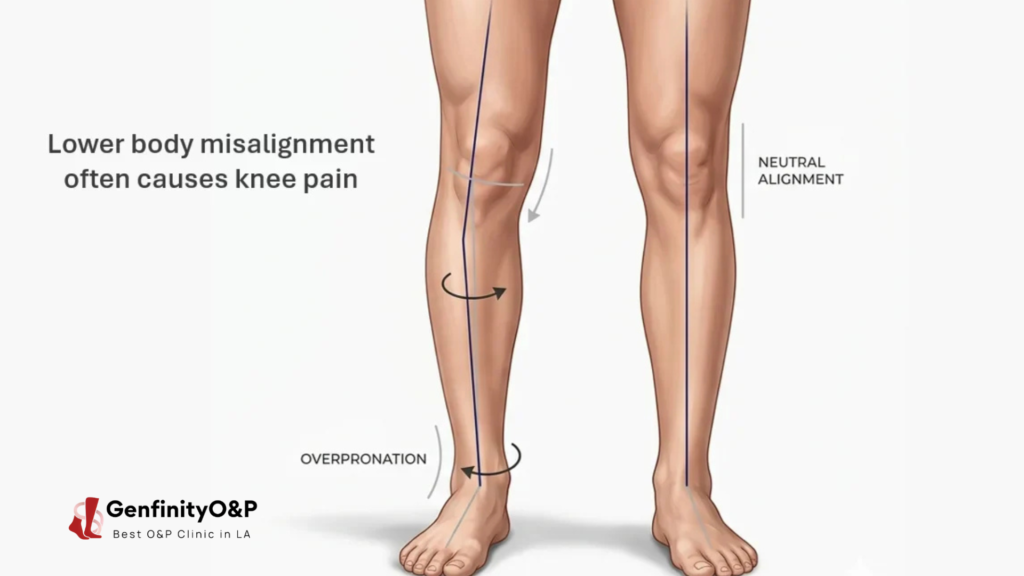
The opposite pattern, called supination, can cause trouble too. A foot that rolls outward too far does not absorb shock well. Each step sends a sharper jolt up the leg, and the knee often takes the brunt of that impact.
Clinical insight. In our clinic, we often see patients who tried knee braces and physical therapy first, with limited results. Once we map their gait and correct foot position, many report less pain within three to four weeks. The knee was never the true source of the problem, the foot was.
Common Knee Conditions Linked to Foot Mechanics
- Patellofemoral pain syndrome, pain around or behind the kneecap
- Iliotibial band syndrome, pain on the outer side of the knee
- Early-stage osteoarthritis, joint pain that worsens with activity
- Medial knee pain linked to flat feet or collapsed arches
A 2021 review in the Journal of Foot and Ankle Research found that foot orthotics reduced patellofemoral pain scores by a meaningful margin compared to no treatment. This supports what we see in clinic on a regular basis.
Take a typical case we see often. A 42 year old runner comes in with outer knee pain that flares after three miles. A gait check shows the foot rolling inward right before push off. Once we add a custom orthotic with a medial post, the rotation eases and the pain drops within two training cycles. This pattern repeats across many patients with similar symptoms.
Knee pain linked to foot mechanics tends to follow a pattern. It often shows up during activity, not at rest. It tends to affect one side more than the other. And it usually improves, even slightly, when walking on soft ground instead of pavement. These clues help us confirm that the feet are part of the picture.
Why Orthotics Help Reduce Knee Pain
Orthotics change the angle of your foot inside the shoe. That small change travels up the kinetic chain and changes how your shin, knee, and hip line up during walking and running.
Correcting Alignment From the Ground Up
A custom orthotic supports the arch in the exact spot your foot needs it. This stops the inward roll before it reaches the knee. With the leg tracking straighter, the kneecap moves through a smoother path and stress on the cartilage drops.
Off the shelf inserts offer some support, but they use a generic shape. A custom orthotic is built from a mold or scan of your actual foot. That precision matters most for people with moderate to severe overpronation, since a generic arch often sits in the wrong place.
Absorbing Shock Before It Reaches the Joint
Every step sends force up through the leg. Orthotics with built-in cushioning absorb part of that force at the foot. Less shock reaches the knee, which matters most for people who run, hike, or stand on hard floors all day.
Research on impact forces shows that even small reductions in shock at the foot can lower cumulative joint stress over thousands of steps. For someone who walks 8,000 to 10,000 steps a day, that reduction adds up fast.
Improving Balance and Gait
Poor foot support can throw off your natural stride. Orthotics restore a more even gait. A steadier stride means less twisting force at the knee with each step you take.
Balance also affects how evenly weight moves through the knee joint during the stance phase of walking. A more even gait spreads pressure across a larger surface of cartilage instead of concentrating it on one small area.
Who Should Consider Orthotics for Knee Pain
Orthotics are not a fit for every type of knee pain. They work best when foot mechanics are part of the problem. The table below outlines common candidates.
Age and activity level also play a role in who benefits most. Active adults between 30 and 60 tend to see the clearest results, since their bodies still adapt well to gait changes. Older adults can benefit too, though results may build more gradually as joint stiffness factors into recovery time.
| Sign or Symptom | Orthotics May Help |
| Flat feet or low arches | Yes, strongly recommended |
| Knee pain after running or walking | Yes, in most cases |
| Shoes wear unevenly on one side | Yes, a sign of poor alignment |
| Knee pain from a direct injury | No, see a doctor first |
If your knee pain pairs with arch collapse, our guide on custom orthotics for flat feet walks through how arch support is fitted and what results to expect.
Plantar Fasciitis and Knee Pain
Plantar fasciitis often changes the way a person walks to avoid heel pain. That shift in gait can stress the knee too. Our article on the best orthotics for plantar fasciitis explains how the right support eases both heel and knee strain at once.
Getting Fitted for Knee-Support Orthotics
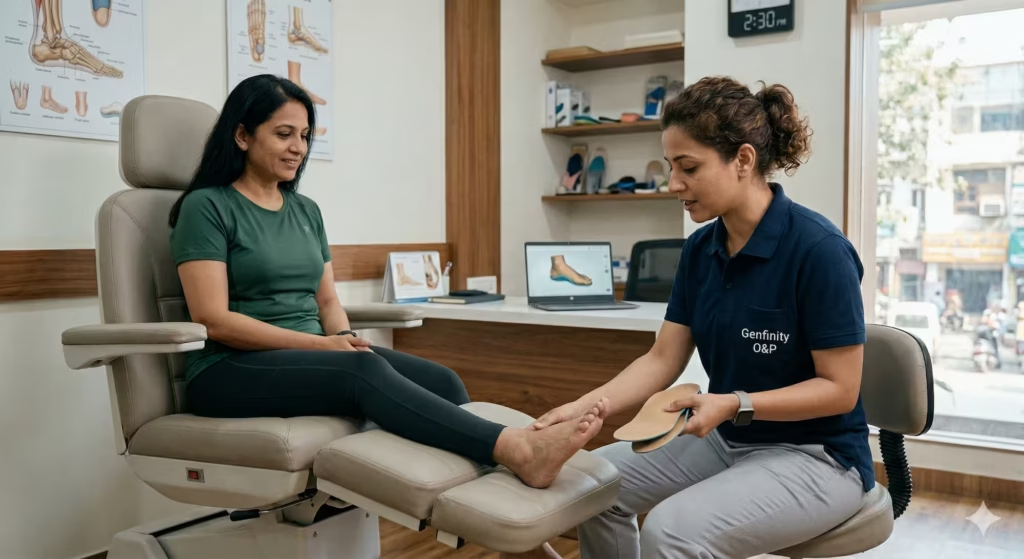
Custom orthotics start with a gait assessment. A clinician watches how you walk and stand, then checks arch height, foot flexibility, and pressure points.
The Fitting Process
- Gait analysis to spot overpronation or supination
- A 3D scan or mold of your foot shape
- Custom build matched to your activity level and shoe type
- A fitting visit to check comfort and pressure points
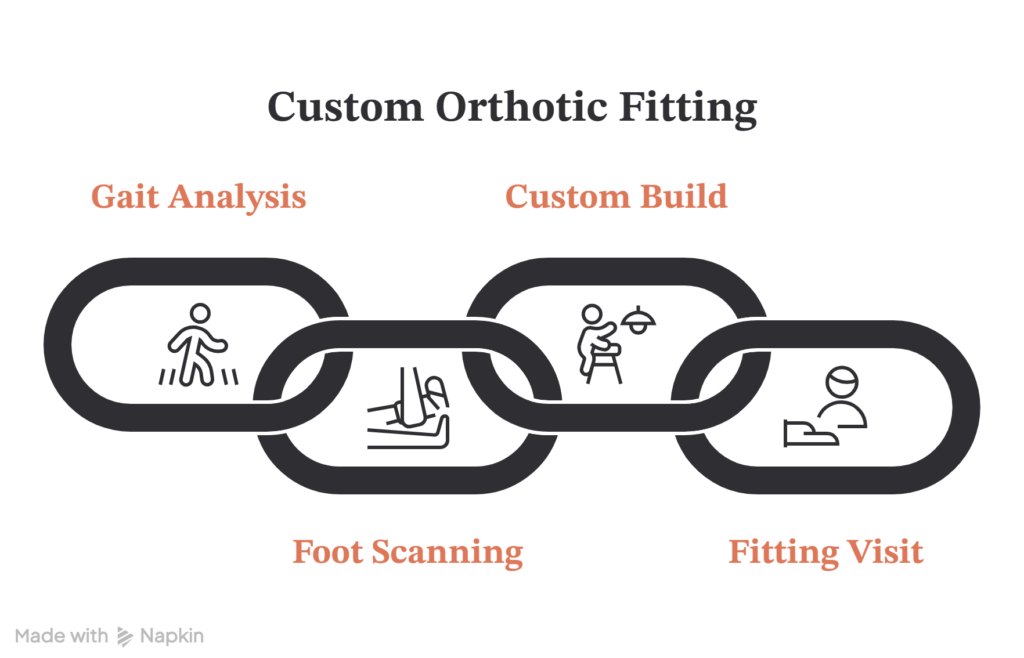
The gait analysis is often the most revealing part of the visit. Many patients are surprised to learn how much their foot rolls during a normal walk, since the motion happens too fast to notice on your own. Video analysis at slow speed makes the pattern clear and gives a starting point for the build.
Most patients need one to two weeks to fully adjust to a new orthotic. Mild soreness in the arch during the first few days is normal and usually fades fast.
We recommend a break in period. Wear the orthotics for two hours on day one, then add an hour or two each following day. This gradual approach lets the foot muscles adapt without strain. Rushing the process tends to cause more soreness, not less.
According to the Mayo Clinic, conservative treatments such as supportive devices are often tried before more invasive knee pain treatments are considered.
Practical Tips for Faster Recovery
Orthotics work best as part of a full recovery plan. These steps help speed up results.
Daily Habits That Support Healing
- Wear your orthotics every day, not just during exercise
- Choose shoes with enough depth to fit the orthotic properly
- Stretch your calves and hamstrings each morning
- Strengthen your quadriceps with light resistance work
- Ice the knee after activity if swelling appears
- Avoid high-impact activity until pain settles down
Strength work deserves special mention. Weak quadriceps and hip muscles let the knee drift out of alignment even with good orthotics in place. Pairing foot support with simple strength exercises, such as wall sits or step ups, tends to produce faster and longer lasting results.
Tracking Your Progress
Keep a simple log of pain levels each week. Note any activity that triggers discomfort and how long it lasts. This record helps your clinician fine tune the orthotic if needed and gives you a clear picture of how recovery is trending.
When to See a Specialist
See a clinician if knee pain lasts more than a few weeks, if swelling does not go down, or if the knee feels unstable. These signs may point to a problem orthotics alone cannot fix.
The American Academy of Orthopaedic Surgeons notes that persistent knee pain should always be checked by a professional to rule out structural damage.
Conclusion
Knee pain often traces back to the feet. Orthotics for knee pain correct foot alignment, absorb shock, and even out your stride. For many people, this simple fix brings real relief without surgery or heavy medication.
If your knees ache after walking, running, or standing, the cause may be sitting right under your feet.
Ready to find out if orthotics can help your knee pain? Book a fitting with Genfinity O&P and take the first step toward pain-free movement.