
Introduction
Every year, millions of Americans rely on orthotics and prosthetics to move without pain, regain function, and live full lives. Whether you have flat feet, plantar fasciitis, or you are recovering after an amputation, the right O&P device can change everything.
This guide covers both sides of orthotic and prosthetic care. You will learn how these devices work, what they cost, and how to find the right fit for your body and lifestyle. We also connect you to related topics already explored in depth on this site, so you can build a full picture of your care options.

Let us start with the basics.
Keypoints
◉ What Are Orthotics and Prosthetics (O&P Care)
◉ Types of Orthotics (Foot, Knee, Spinal, Pediatric)
◉ Types of Prosthetics (Below-knee, Above-knee, Arm, Advanced Devices)
◉ Custom Orthotics vs OTC Insoles Comparison Guide
◉ Common Conditions Treated with Orthotics
◉ Prosthetic Technology (Microprocessor & AI-Based Devices)
◉ Cost of Orthotics and Prosthetics in the USA
◉ Insurance & Medicare Coverage for O&P Devices
◉ O&P Fitting and Treatment Process Step-by-Step
◉ How to Choose the Right Orthotics and Prosthetics Provider
What Are Orthotics and Prosthetics
Defining O&P Care
Orthotics and prosthetics are two distinct but connected fields of medicine. Both fall under the broader term O&P care. Each one serves a different purpose, though the goal is the same: to restore or improve physical function.
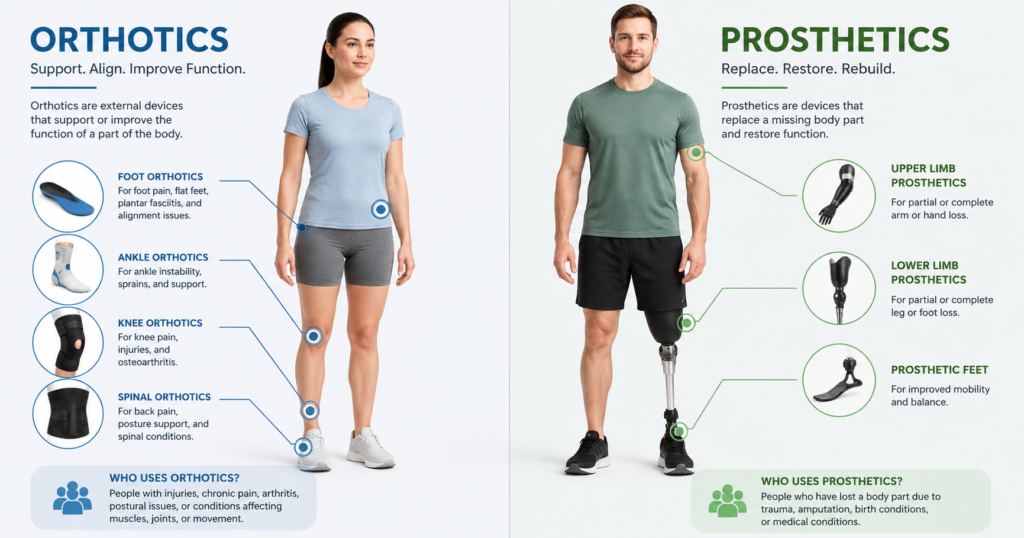
An orthotic is a device worn inside or outside the body to support, correct, or improve the movement of a body part. A prosthetic is a device that replaces a missing limb or body part. Together, these tools serve millions of patients across the United States each year.
What Is an Orthotic
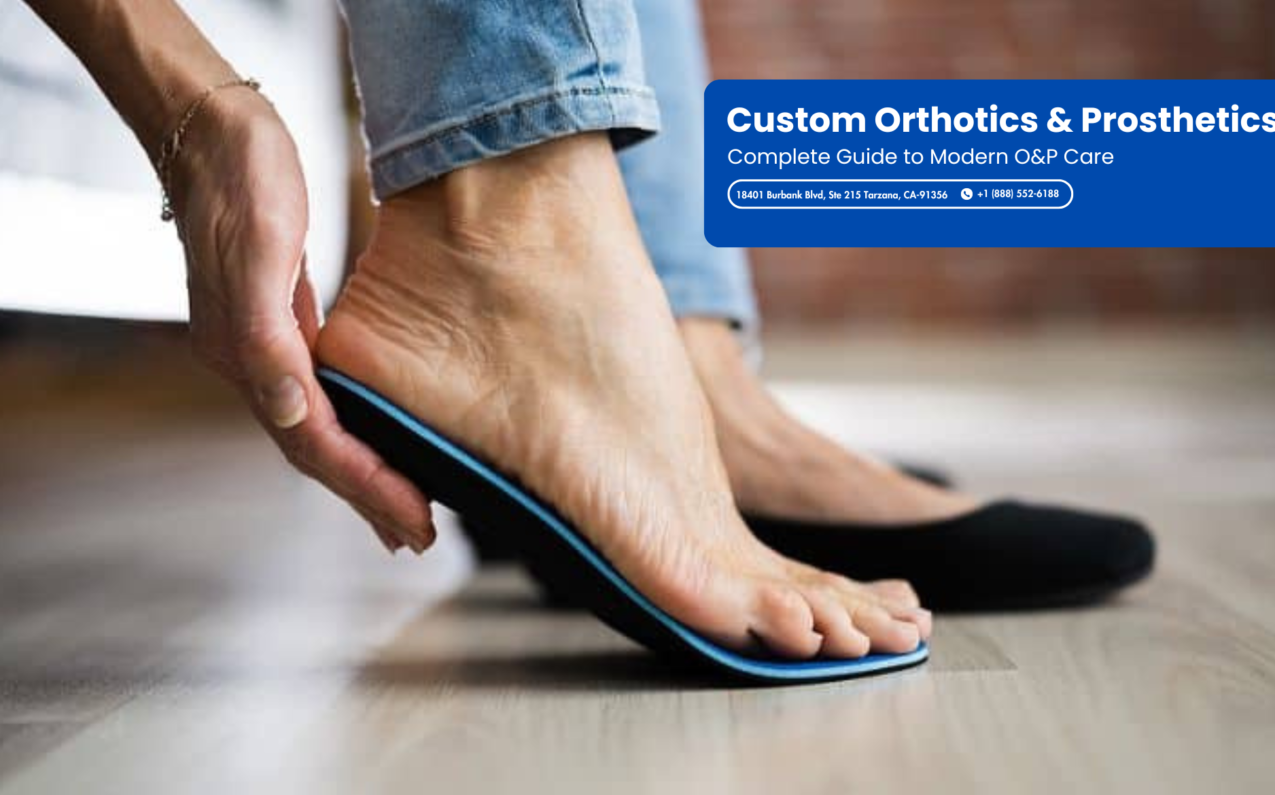
An orthotic is a support device. It can be as simple as an insole placed inside a shoe or as complex as a full leg brace. Orthotics are prescribed for many conditions, including flat feet, plantar fasciitis, overpronation, scoliosis, arthritis, and diabetic foot complications.
There are two broad categories of orthotics: off-the-shelf and custom. Off-the-shelf orthotics are mass-produced and sold in pharmacies or online. Custom orthotics are made from a mold of your exact foot or body part and designed for your specific condition.
If you are weighing which is better for your situation, our in-depth article on
Custom Orthotics vs OTC Insoles breaks down the differences in cost, effectiveness, and durability.
What Is a Prosthetic
A prosthetic is a replacement for a limb or body part that has been lost due to amputation, injury, or a condition present at birth. Prosthetics have advanced significantly over the past two decades. Today, they can replicate complex movements and even respond to nerve signals.
Common types include below-knee prosthetics, above-knee prosthetics, prosthetic arms and hands, and partial foot prosthetics. Advanced options include microprocessor-controlled knees and myoelectric limbs that move with electrical signals from your muscles.
What are custom orthotics and prosthetics
Custom orthotics and prosthetics are specialized medical devices designed to support or replace parts of the body. Orthotics help correct or improve the function of the feet and limbs, while prosthetics are artificial devices used to replace missing body parts. Both are custom-made to enhance mobility, reduce pain, and improve overall quality of life.
Types of Orthotics and What They Treat
Foot and Ankle Orthotics
Foot orthotics are the most common type. They are used to treat a wide range of conditions, from everyday foot pain to more serious biomechanical problems. Most people who seek orthotics start here.
The most frequently treated conditions include plantar fasciitis, flat feet, overpronation, heel spurs, bunions, and diabetic foot issues. Each condition requires a different design and material.
Flat Feet
Flat feet occur when the arch of the foot collapses and the entire sole touches the ground. This causes strain on muscles, tendons, and joints up the entire leg. The right orthotic provides arch support and corrects foot alignment.
For a detailed look at top-rated options, read our guide on the Best Custom Orthotics for Flat Feet to find the most effective designs tested for this condition.
Plantar Fasciitis
Plantar fasciitis is one of the most common causes of heel pain in the United States. It affects over two million people each year. The plantar fascia, a thick band of tissue along the bottom of the foot, becomes inflamed and painful, especially in the morning.
Orthotics for this condition need to cushion the heel, support the arch, and reduce strain on the fascia. The design matters as much as the material.
Our full review of the Best Orthotics for Plantar Fasciitis 2026 covers tested options across different shoe types and foot shapes.
Overpronation
Overpronation is when the foot rolls inward too far with each step. It affects the alignment of the entire lower body and can lead to shin splints, knee pain, and hip problems over time.
If you are not sure whether you overpronate, our article What Is Overpronation explains the signs, causes, and treatment options in plain language.
Knee, Hip, and Spinal Orthotics
Orthotics are not limited to the foot. Knee braces, hip abduction braces, and spinal orthoses are all part of the same family. These devices are used after surgery, to manage chronic pain, or to prevent injury progression.
Knee orthotics are common in sports medicine and post-surgical recovery. Spinal braces are used for scoliosis, spinal fractures, and post-operative support. Each device is either custom-made or fitted off-the-shelf depending on the severity of the condition.
Pediatric Orthotics
Children have different orthotics needs than adults. Pediatric orthotics focus on correcting developmental issues such as in-toeing, toe-walking, clubfoot, and gait abnormalities. Early intervention often reduces the need for more intensive treatment later.
A certified orthotist evaluates the child’s gait, foot structure, and growth pattern before prescribing a device. Growth also means that devices need to be replaced more often compared to adult orthotics.
Custom Orthotics vs Off-the-Shelf Insoles
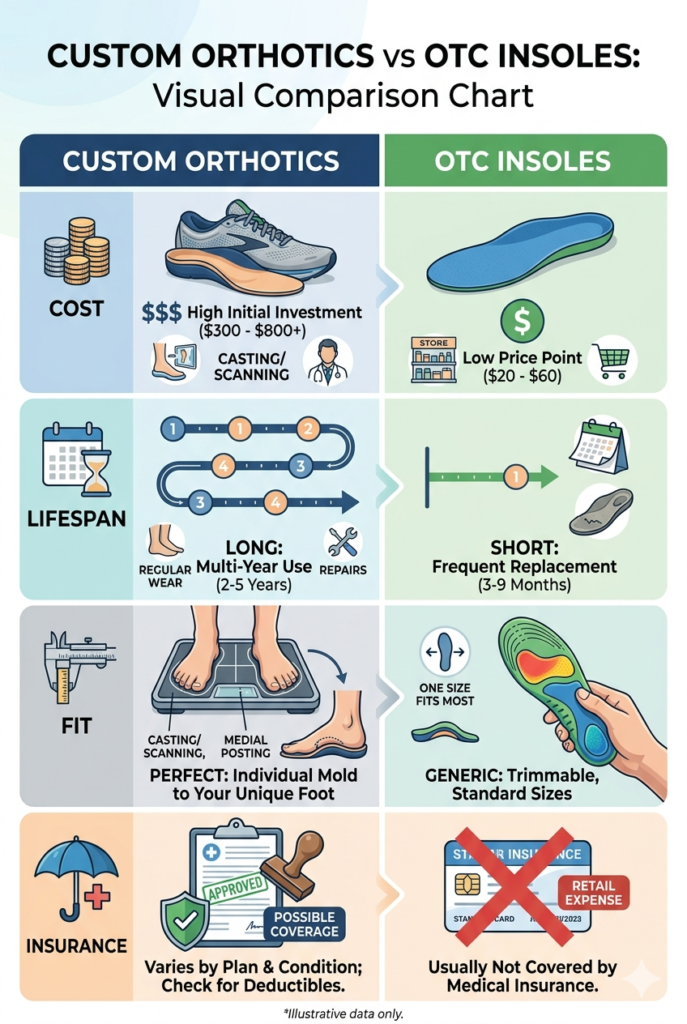
One of the most common questions patients ask is whether they should buy custom orthotics or try an over-the-counter insole first. The answer depends on the severity of your condition and your long-term goals.
Here is a side-by-side comparison to help you decide:
| Feature | Custom Orthotics | OTC Insoles |
| Fit | Made for your exact foot shape | Generic, one-size fit |
| Cost | $200 to $800+ | $10 to $80 |
| Lifespan | 3 to 5 years | 3 to 12 months |
| Conditions Treated | Flat feet, plantar fasciitis, diabetes | Mild discomfort only |
| Insurance Coverage | Often covered | Rarely covered |
| Prescription Required | Yes | No |
| Clinical Effectiveness | High for complex cases | Moderate for mild cases |
For mild discomfort or general support, an OTC insole may be a good starting point. But for diagnosed conditions like plantar fasciitis, overpronation, or diabetes-related foot issues, a custom orthotic is usually more effective and safer in the long run.
Read our complete breakdown: Custom Orthotics vs OTC Insoles for side-by-side testing results and expert recommendations.
How Much Do Orthotics Cost in the USA
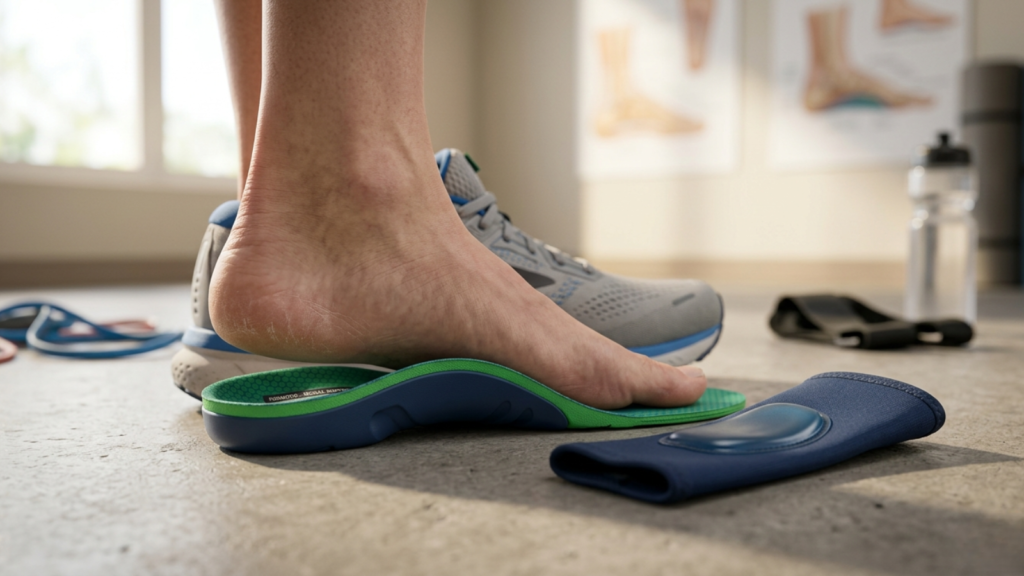
Orthotic Pricing by Type
The cost of orthotics varies widely. A basic OTC insole from a pharmacy might cost between $15 and $80. A pair of custom functional orthotics can range from $200 to $800 or more, depending on the materials, provider, and location.
Here is a general breakdown of what you can expect to pay in the United States in 2024:
| Orthotic Type | Typical Cost | Notes |
| OTC Insoles | $15 to $80 | No prescription needed |
| Prefabricated Custom-Fit | $100 to $300 | Fitted to foot but not molded |
| Custom Functional Orthotics | $200 to $600 | Molded from foot cast or scan |
| Custom Ankle-Foot Orthosis (AFO) | $500 to $2,500 | For gait and neurological conditions |
| Pediatric Orthotics | $150 to $500 | May need replacement every 6 to 12 months |
Does Insurance Cover Orthotics
Coverage depends on your insurance plan and the medical necessity of the device. Medicare Part B covers orthotics when they are prescribed by a physician and deemed medically necessary. Many private insurers follow similar criteria.
Key factors that affect coverage include your diagnosis code, whether the device is custom or prefabricated, and whether your provider is in-network. Always get a prescription and a letter of medical necessity before purchasing.
For a complete breakdown of costs, insurance tips, and money-saving options, visit our Orthotics Cost Guide which covers everything from deductibles to FSA eligibility.
The Prosthetics Side of O&P Care
Who Needs a Prosthetic
According to the Amputee Coalition, nearly 2.1 million people in the United States are living with limb loss. Moreover, this number is expected to double by 2050, primarily due to diabetes and vascular disease. Therefore, understanding proper care, including the fact that children have different orthotics needs than adults, is becoming increasingly important. Each of these individuals needs some form of prosthetic care.
In addition, prosthetics are also used by people with congenital limb differences. Furthermore, they support individuals who have lost limbs due to trauma or cancer. As a result, they also help those whose limb function has been significantly impaired, improving overall mobility and quality of life.. The right prosthetic can dramatically improve independence and quality of life.
Types of Prosthetic Devices
Prosthetics fall into several categories based on the level of amputation and the patient’s activity goals:
- Transtibial (below-knee) prosthetics for amputations below the knee
- Transfemoral (above-knee) prosthetics for higher-level amputations
- Transradial and transhumeral prosthetics for arm and hand replacements
- Partial foot and partial hand prosthetics for incomplete amputations
- Microprocessor-controlled prosthetics that adapt to terrain in real time
- Activity-specific prosthetics for running, swimming, or climbing
Modern Prosthetic Technology
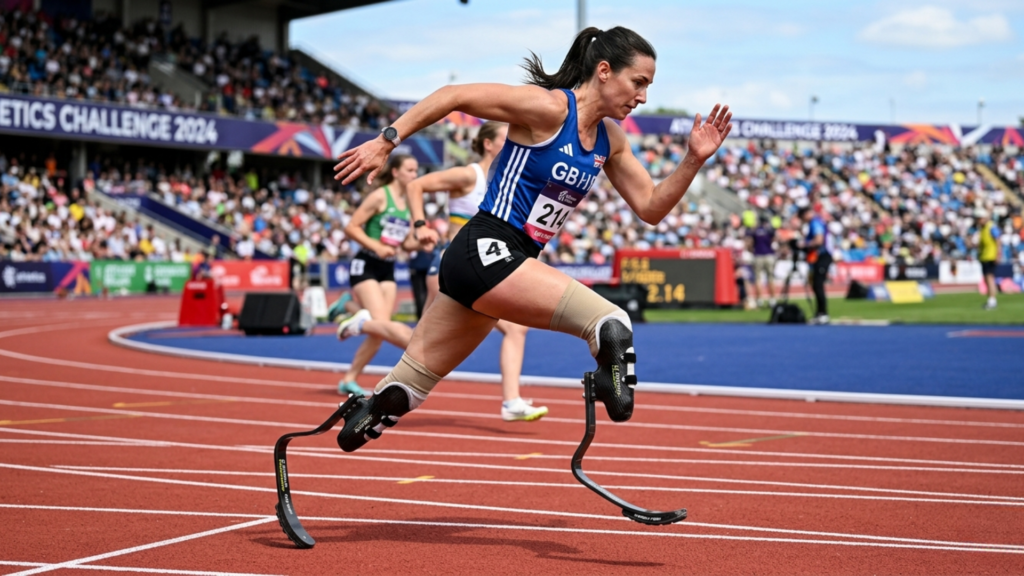
Prosthetic technology has advanced rapidly in the past decade. Microprocessor knees can sense ground conditions and adjust resistance automatically. Myoelectric hands respond to muscle signals and can perform grip patterns with precision.
Carbon fiber feet are lighter and more responsive than older designs. Osseointegration, a process where the prosthetic is attached directly to the bone, is now available for some patients. This eliminates socket discomfort entirely.
For people who want to return to athletics, running blades and sports-specific prosthetics have made high-level activity possible. Paralympic athletes compete at world-class levels using these devices.
According to the American Academy of Orthotists and Prosthetists (AAOP), patients who receive prosthetic care from a certified prosthetist within 30 days of amputation have significantly better functional outcomes than those who wait.
Prosthetic Cost Overview
Prosthetics are expensive. Costs vary based on the type of device, the technology used, and the level of customization required. Below is a general cost reference for 2024:
| Prosthetic Type | Average Cost (USD) | Insurance Typical Coverage |
| Below-Knee (Transtibial) | $5,000 to $50,000 | 50% to 80% |
| Above-Knee (Transfemoral) | $10,000 to $70,000 | 50% to 80% |
| Microprocessor Knee | $30,000 to $100,000+ | Case-by-case |
| Myoelectric Arm | $20,000 to $100,000 | 50% to 70% |
| Dynamic Carbon Foot | $1,000 to $20,000 | Often covered |
| Sports/Activity Prosthetic | $5,000 to $30,000 | Limited |
Insurance coverage for prosthetics is more complex than for orthotics. Medicare covers prosthetics under Part B when they are medically necessary and prescribed by a licensed physician. However, coverage for advanced technology such as microprocessor knees can require additional documentation and appeals.
If you are navigating prosthetic insurance claims, working with a certified prosthetist who has experience in billing and documentation will save you time and money.
The O&P Fitting Process
Step 1: Medical Evaluation and Referral
The process starts with your doctor. A physician, podiatrist, orthopedic surgeon, or physical therapist must evaluate your condition and write a prescription or referral for orthotic or prosthetic care. This step is important for insurance purposes.
Your evaluation will include a review of your medical history, current symptoms, imaging results, and mobility assessment. For prosthetics, this also includes a review of your activity goals and rehabilitation timeline.
Step 2: Assessment with a Certified Clinician
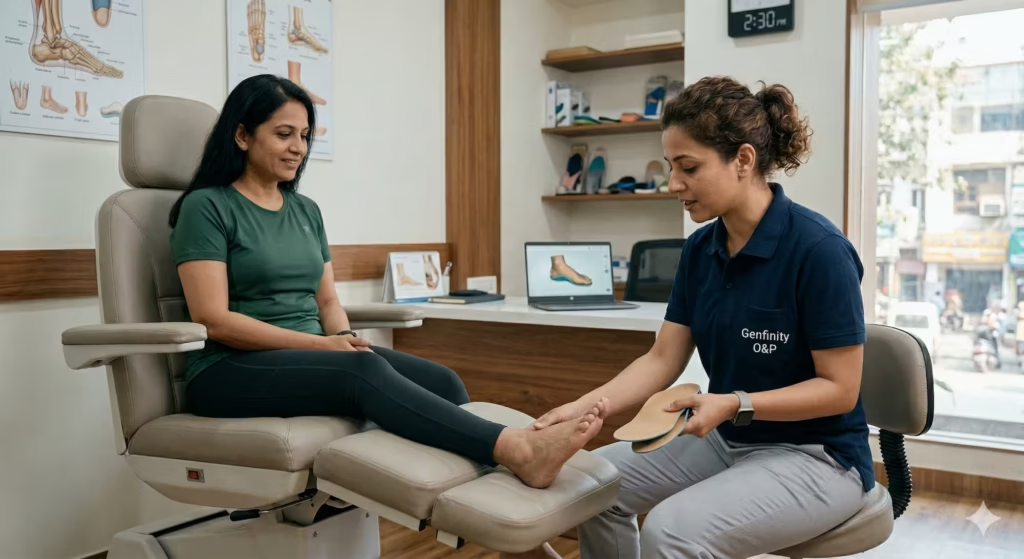
A certified orthotist or prosthetist (CO or CP) performs a detailed assessment. This includes gait analysis, range-of-motion testing, and measurements. For foot orthotics, a plaster cast or 3D scan of your foot is taken. For prosthetics, a full assessment of the residual limb is conducted.
This step also includes a conversation about your lifestyle, goals, and activity level. A triathlete and a desk worker with the same diagnosis may need very different devices.
Step 3: Design and Fabrication
The device is designed based on your assessment and fabricated in a lab or clinic. Custom foot orthotics typically take one to two weeks. Prosthetics take longer, often two to six weeks, depending on complexity.
Materials used include thermoplastics, carbon fiber, foam, leather, and silicone. The material choice affects weight, flexibility, durability, and cost.
Step 4: Fitting and Adjustment
Once fabricated, the device is fitted and adjusted. Multiple fittings may be needed. This step is critical. A poorly fitted orthotic or prosthetic causes pain and can worsen the underlying condition.
Your clinician will observe your gait and movement during this step. Adjustments may include trimming edges, adding padding, or modifying alignment. For prosthetics, alignment adjustments are essential for energy-efficient walking.
Step 5: Follow-Up and Ongoing Care
Orthotics and prosthetics require maintenance and periodic replacement. Foot orthotics typically last three to five years with proper care. Prosthetic components such as feet and knees may need replacement every three to five years as well.
Regular follow-up appointments allow your clinician to monitor fit, function, and wear. This is especially important for children, whose bodies change rapidly, and for prosthetic users, who may experience changes in residual limb volume over time.
Finding the Right Shoes for Your Orthotics
Wearing the right shoes matters just as much as having the right orthotic. A well-made orthotic placed in a poorly designed shoe will not perform as expected. The shoe needs to have removable insoles, adequate depth, and a wide enough toe box.
Key features to look for in orthotic-friendly shoes include:
- A removable factory insole to create space for the orthotic
- Deep heel cup for better stabilization
- Firm midsole for better support and energy return
- Wide toe box to avoid compression
- Minimal drop for natural foot positioning in functional orthotics
We have tested and reviewed dozens of footwear options. See our full guide: Best Shoes for Orthotics with recommendations for different conditions and lifestyles.
Shoe selection also depends on your activity type. Running shoes, walking shoes, work boots, and dress shoes each have different structures. An orthotic that works well in a running shoe may not fit comfortably in a dress shoe.
Practical Tips for Getting the Most From O&P Care
Tips for Orthotic Users
Getting the right orthotic is only step one. How you use and care for it determines how well it works over time.
- Break in new orthotics gradually. Start with two to three hours per day and increase over one to two weeks
- Wear them consistently. Orthotics work best when used daily, not just when pain flares
- Rotate between two pairs of shoes if possible. This gives orthotics time to recover their shape
- Clean orthotics weekly with a damp cloth. Avoid soaking them in water
- Replace worn orthotics on schedule. Worn devices lose their corrective value
- Tell your clinician about any new pain or discomfort right away
Tips for Prosthetic Users
Adjusting to a prosthetic takes time, patience, and consistent rehabilitation. Clinicians base these tips on their experience and use them to support your progress.
Select 86 more words to run Humanizer.
- Follow your physical therapy plan. Rehab is not optional. It is what makes the prosthetic functional
- Monitor your residual limb daily for skin breakdown, redness, or swelling
- Maintain a consistent limb volume. Changes in weight or fluid can affect socket fit
- Communicate with your prosthetist regularly. Small adjustments prevent big problems
- Set realistic activity goals. Progress takes weeks to months, not days
- Explore peer support. Organizations like the Amputee Coalition offer mentorship programs
When to Seek a Second Opinion
If your orthotic or prosthetic causes persistent pain, does not improve your function, or breaks down quickly, it may be time to seek a second opinion. Not all O&P providers are equal. Look for clinicians who are certified by the American Board for Certification in Orthotics, Prosthetics and Pedorthics (ABC) or the Board of Certification/Accreditation (BOC).
A certified professional will have the letters CO, CP, CPO, or CFo after their name. Always verify credentials and ask about experience with your specific condition.
The Role of Technology in Modern O&P Care
3D Scanning and CAD/CAM Fabrication
Clinicians are increasingly replacing traditional casting methods with 3D scanning. A scan captures the exact contours of your foot or residual limb in seconds. Clinicians then use the data to design and fabricate the device with computer-aided design (CAD) and computer-aided manufacturing (CAM) systems.
3D scanning improves accuracy, reduces fitting errors, and speeds up the process. Many clinics now offer this technology as a standard part of their workflow.
Artificial Intelligence in Prosthetics
AI-powered prosthetics are no longer experimental. Microprocessor knees and ankles use onboard computers to adjust to your walking pattern in real time. Some devices learn your gait over time and optimize performance automatically.
Research published in leading rehabilitation journals shows that microprocessor prosthetics reduce fall rates and improve walking speed compared to mechanical devices. The tradeoff is cost, which can reach $100,000 or more for advanced systems.
Telehealth and Remote O&P Monitoring
Telehealth has changed how O&P care is delivered. Many clinics now offer virtual consultations for follow-up appointments, minor adjustments, and troubleshooting. Remote sensor technology built into prosthetic components can transmit data to your clinician for real-time monitoring.
This is especially valuable for patients in rural areas who may live hours from the nearest O&P clinic. Virtual care is not a substitute for in-person fitting, but it extends access and improves continuity.
Insurance, Medicare, and Medicaid Coverage for O&P
Medicare Coverage Basics
Medicare Part B covers orthotics and prosthetics as durable medical equipment (DME) when a physician prescribes them and determines that they are medically necessary. Coverage is 80 percent of the Medicare-approved amount. You pay the remaining 20 percent after meeting your deductible.
For prosthetics, Medicare uses a four-functional-level (K-level) classification to determine what devices are covered. Patients classified at K0, meaning they cannot walk or have no potential for ambulation, typically do not qualify for a functional prosthetic. Patients at K2 through K4 have increasing access to more advanced devices.
Medicaid Coverage
Medicaid coverage for O&P devices varies significantly by state. Some states offer comprehensive coverage; others have strict limitations. If you are on Medicaid, check with your state’s program directly and ask your O&P provider to assist with prior authorization.
Private Insurance
Private insurance plans differ widely. Some require a prior authorization before fitting. Others have annual benefit caps. Always call your insurer before starting the O&P process to understand what is covered and what documentation is required.
Requesting a letter of medical necessity from your physician and a detailed clinical justification from your O&P provider greatly improves your chances of approval.
For authoritative guidance on insurance and Medicare coverage, visit the American Academy of Orthotists and Prosthetists at
the AAOP official website and the Amputee Coalition resource center at amputee-coalition.org for peer support and educational materials.
Internal Resource Hub: Related Topics Worth Reading
O&P care is a broad field, and understanding one topic often leads to questions about another. Below are the most relevant guides we have already published to help you go deeper on the topics that matter most to you.
- Best Orthotics for Flat Feet – Tested options for arch support and pain relief
- Best Orthotics for Plantar Fasciitis – Top-rated insoles reviewed for heel pain and fascia support
- What Is Overpronation – Signs, causes, and how to correct it with the right device
- Custom Orthotics vs OTC Insoles – Side-by-side comparison with real-world results
- Orthotics Cost Guide – Full pricing breakdown and insurance tips for the USA
- Best Shoes for Orthotics – Footwear tested for orthotic compatibility across conditions
Conclusion
Custom orthotics and prosthetics are life-changing tools for millions of Americans. When properly prescribed, fitted, and maintained, they reduce pain, restore mobility, and improve quality of life in measurable ways.
The field of O&P care has never been more advanced. From 3D-scanned custom foot orthotics to AI-powered prosthetic knees, patients today have more options than ever before. The key is working with a certified professional, understanding your coverage, and staying committed to the process.
Whether you are managing plantar fasciitis, overpronation, flat feet, or recovering from an amputation, the right device is out there. Use this guide as your starting point. Explore the related articles on this site for deeper insight into each topic.
And if you are ready to take the next step, book a consultation with a certified orthotist or prosthetist in your area. Your path to better movement starts with one appointment.
Ready to find the right O&P solution for you? Browse our complete library of orthotics guides above, or speak with a board-certified clinician near you. Getting the right device is the first step toward pain-free movement.