

Knee pain is one of the most common complaints I hear from patients. It slows people down. It makes simple tasks like walking up stairs feel difficult. And it affects millions of people every year.
According to the American Academy of Orthopaedic Surgeons, about 25% of adults deal with frequent knee pain. For many of them, orthotics for knee pain offer a practical, non-invasive way to find relief.
In this article, I will explain what orthotics are, how they work, and which types may help you the most. You will also find a comparison table, practical tips, and guidance on when to see a professional.
What Are Orthotics and How Do They Support the Knee
Orthotics are specially designed shoe inserts or devices that support your feet and lower limbs. They sit inside your footwear and work by correcting the way your foot makes contact with the ground.
You might wonder how a shoe insert helps your knee. The answer is biomechanics. The way your foot moves affects everything above it, including your ankles, knees, hips, and lower back.
When your foot rolls inward too much (overpronation) or outward too much (supination), it changes the angle at your knee joint. Over time, this uneven load causes pain and wear.
The Link Between Foot Alignment and Knee Pain
Poor foot alignment places extra stress on the knee joint. This is especially true during walking or running. A study published in the Journal of Orthopaedic Research found that corrective foot orthotics reduced knee joint loading by up to 6% in people with knee osteoarthritis.
Foot orthotics knee relief works by shifting load away from the painful part of the joint. They also improve your overall walking mechanics, which reduces strain over time.
Types of Orthotics for Knee Pain
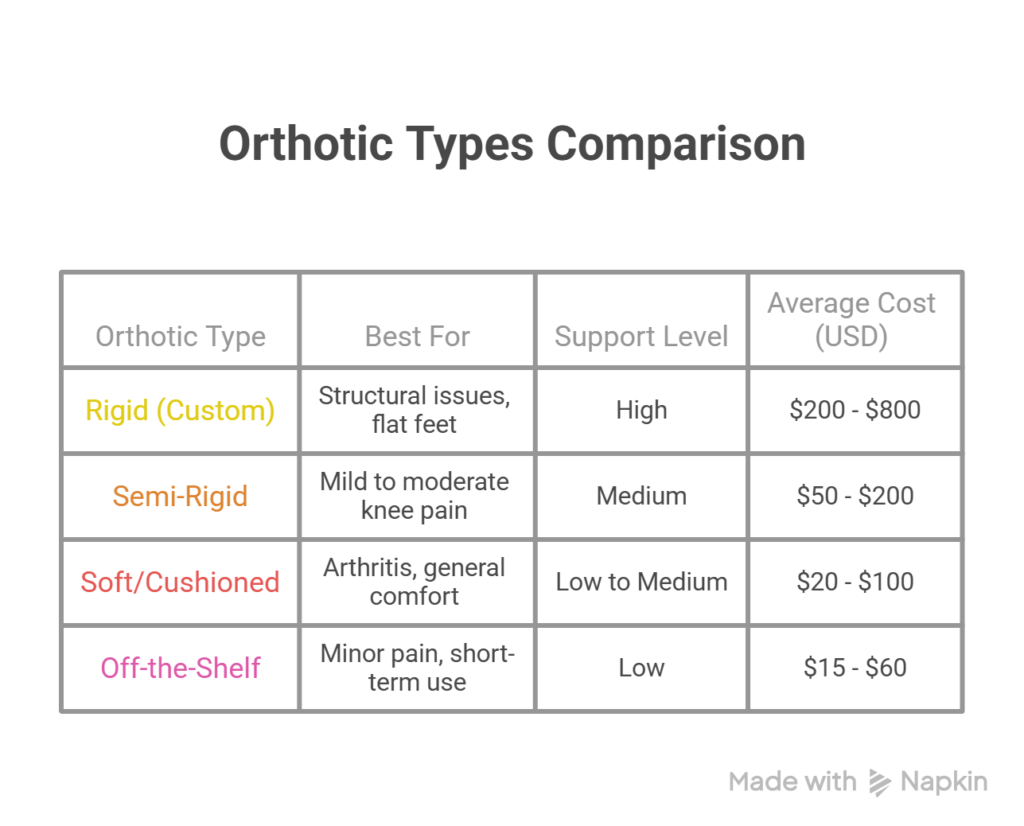
Not all orthotics are the same. The right type depends on your pain level, your foot shape, and your daily activities. Here is a breakdown of the main types.
Custom Orthotics
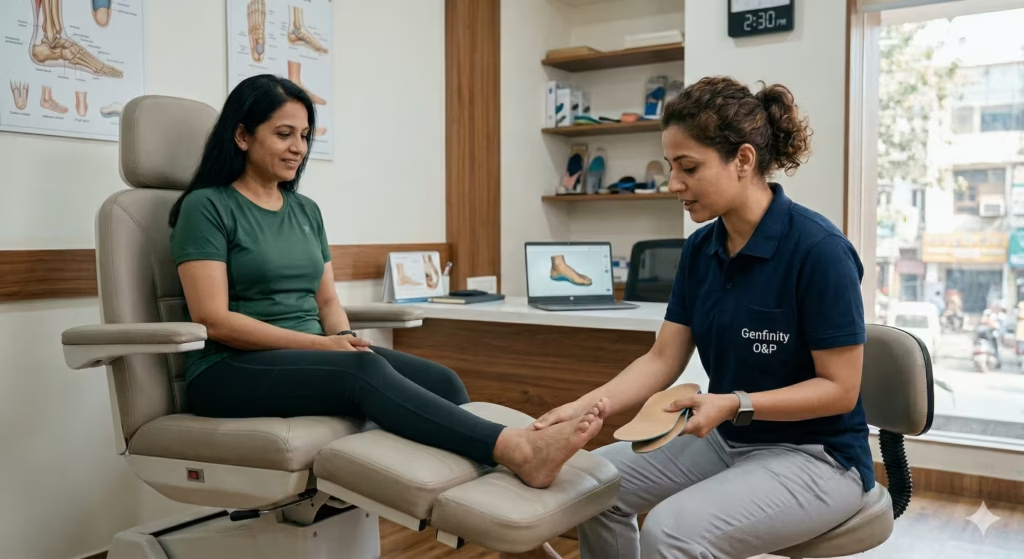
A podiatrist or orthotist creates these after a full assessment of your foot and gait. They are molded to fit your foot exactly. Custom orthotics are best for people with structural foot problems or chronic knee pain.
Semi-Rigid Orthotics
These offer a balance of support and flexibility. They are a good middle ground for mild to moderate knee pain. Many athletes and active adults use them.
Soft or Cushioned Orthotics
These are made from foam or gel materials. They absorb shock and reduce pressure. They work well for older adults and those with arthritis.
Off-the-Shelf Orthotics
You can buy these at a pharmacy or sports store without a prescription. They are less expensive but offer less targeted support. They suit minor discomfort or short-term use.
Orthotic Types at a Glance
Note: Prices vary by region and provider. Custom orthotics may be covered by health insurance.
Who Can Benefit from Knee Support Insoles
Knee support insoles can help a wide range of people. You do not have to be an athlete or have a serious condition to benefit.
People with Osteoarthritis
Knee osteoarthritis affects over 32.5 million adults in the United States alone. Orthotics can reduce pain by offloading stress from the damaged part of the knee. Lateral wedge insoles, in particular, have shown measurable benefits for medial knee OA.
Runners and Athletes
High-impact sports place repeated stress on the knee. Foot orthotics help distribute this load more evenly. Many runners use them to prevent injuries like patellofemoral pain syndrome (runner’s knee).
People Who Stand All Day
Teachers, nurses, retail workers, and others who stand for long hours often develop knee pain. Cushioned insoles reduce fatigue and protect the joint over time.
Those Recovering from Knee Surgery
After procedures like ACL repair or knee replacement, orthotics help retrain proper movement patterns. They support recovery and reduce the risk of re-injury.
Practical Tips for Using Orthotics and Recovering from Knee Pain
Using orthotics is just one part of managing knee pain. Here are some tips I recommend to my patients for the best results.
Getting Started with Orthotics
- Start slowly. Wear your new orthotics for 2 to 3 hours on the first day. Increase wearing time by an hour each day over two weeks.
- Wear them in the right shoes. Orthotics work best in supportive, lace-up footwear with a removable insole.
- Be patient. Most people notice improvement within 4 to 6 weeks of consistent use.
- Replace them regularly. Soft orthotics wear out faster. Check them every 6 to 12 months.
- Get a professional fit if pain is severe. Off-the-shelf options may not give you the support you need.
Supporting Recovery Beyond Orthotics
Orthotics work best as part of a broader approach to knee pain management.
- Strengthen the muscles around your knee, especially the quadriceps and hamstrings.
- Maintain a healthy weight. Each extra pound adds roughly 4 pounds of pressure to the knee joint.
- Stretch daily, focusing on the calves, hamstrings, and hip flexors.
- Apply ice after activities that cause swelling or discomfort.
- Avoid high-impact activities during flare-ups and switch to swimming or cycling instead.
Expert Insight: As a clinician, I have seen the biggest results when patients combine orthotics with targeted exercise. Neither works as well alone. The orthotic corrects the mechanics; the exercise builds the strength to sustain it.
When to See a Doctor or Podiatrist
Orthotics can help a great deal, but they are not a cure for all knee conditions. There are times when you need professional advice.
- Your knee pain is severe or getting worse despite using orthotics.
- You have swelling, redness, or warmth around the knee joint.
- You have recently had a fall or injury that affected your knee.
- Pain is disrupting your sleep or daily activities.
- You are unsure whether your foot mechanics are contributing to the problem.
A podiatrist can perform a full gait analysis and fit you with custom orthotics if needed. Your doctor may also refer you for physiotherapy or imaging to rule out structural damage.
Trusted Resources for Knee Pain and Orthotics
For more detailed clinical information on orthotics and knee health, I recommend reviewing guidance from the American College of Rheumatology and the American Academy of Orthopaedic Surgeons. Both organizations publish up-to-date research and patient guides on managing knee conditions safely.
Conclusion
Orthotics for knee pain offer a simple and effective way to reduce discomfort and improve how you move. They correct foot alignment, reduce stress on the knee joint, and support your recovery over time.
Whether you are dealing with arthritis, recovering from surgery, or managing pain from an active lifestyle, the right orthotic can make a real difference. Start with a good pair of off-the-shelf insoles or consult a podiatrist for a custom fit.
Small changes in how your foot meets the ground can have a big impact on your knee health. Take that first step today.